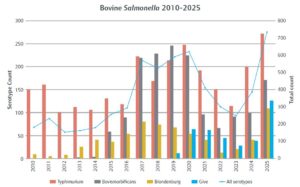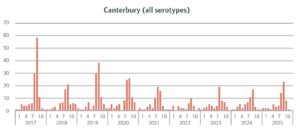
Salmonellosis has long been recognised as an important cause of disease in cattle. Based on information from the country’s veterinary diagnostic laboratories, MPI has observed an increase in the incidence of salmonellosis in dairy cattle since the spring of 2024.
The trend of increasing salmonella cases, first observed in spring of 2024, extended into the spring of 2025, with a significant number of cases continuing to be reported (see figure right).
Of particular note, for the Southland region, there has been a marked increase in cases due to the serotype Salmonella Bovismorbificans. This serotype has been associated with more severe disease than is observed with Salmonella Typhimurium, the predominant serotype in the region. Additionally, as of September 2024, cases of Salmonella Give were reported from this region. This serotype arose in 2019 and had been exclusively confined in the North Island. However, as of February 2026, the first case of Salmonella Give has been diagnosed in Mid Canterbury as well.
Vaccination of herds is the cornerstone of protection against salmonella, though it must be acknowledged that Salmonella Give is not covered in the routine salmonella vaccine. Many farms may have fallen outside their normal vaccination regimes due to a vaccine outage last autumn. This year, vaccine stocks appear to be in reasonable supply. It would be recommended to have a discussion with your Vetlife veterinarian should you be considering protecting your herd from a salmonella outbreak. Avoiding cow losses, losses in production and avoiding the human health risk aspect, make a consideration towards vaccinating well worthwhile.