Line Ferriman is a veterinarian
and co-founder of CowSmart,
a technology-agnostic data consultancy
helping dairy farms and their vets
make smarter decisions across New Zealand
Every season, there is pressure to find the thing that will shift performance:
In reality, improvements rarely come from a single change. Farming is complex, and success depends on both the farm’s objectives and the many factors that shape an efficient, productive, and sustainable cow. These are the principles on which CowSmart is built.
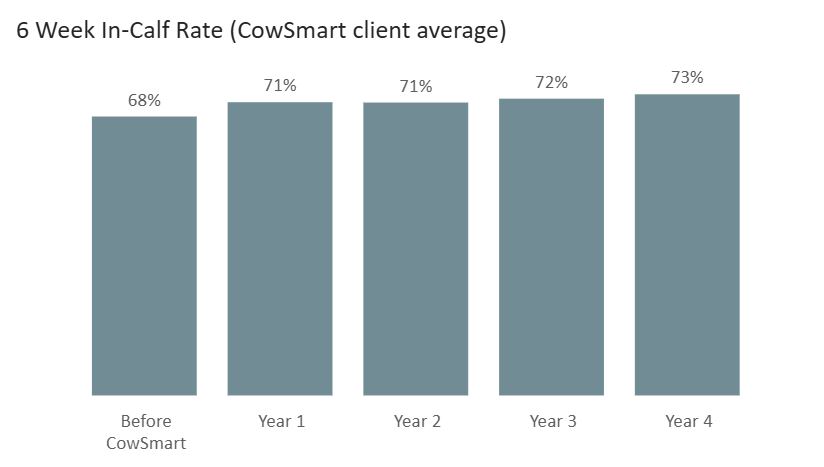
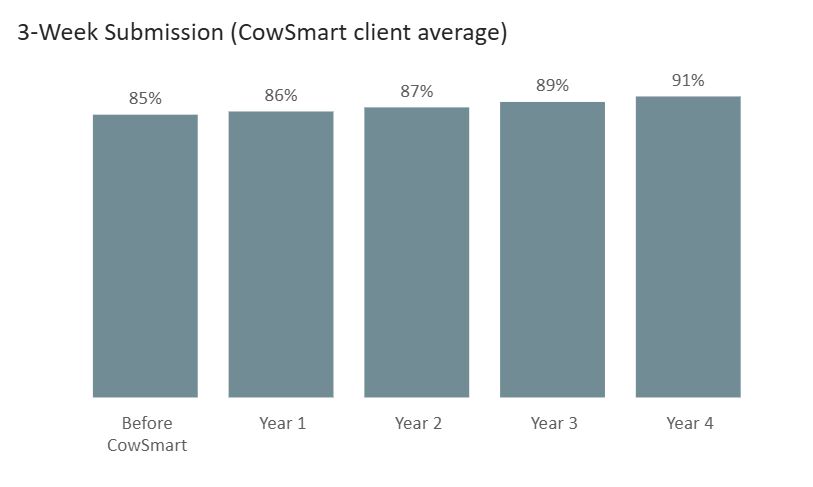
The results below come from herds working within the CowSmart framework across multiple seasons, and they reflect an overall trend – not a single farm, and not a single approach:
3-week ICR moves from 46% to around 52–53%
6-week ICR from 68% to around 72–73%
3-week Submission rate from 85% to around 91%.

Some farms have seen modest changes. Others have shifted more dramatically.
There is rarely one thing that explains it.
So the more useful question is not: “what was the one thing that changed everything?”
It is: what changed in the way the herd was managed?
There is a strong tendency to link transition directly to cycling performance. That link is not always as clean as we would like it to be. What we can say, from both data and observation, is that cows that transition smoothly tend to recover faster. That sounds simple, but it has practical implications. When cows recover faster, fewer animals are sitting behind the herd as mating approaches. Fewer require intervention. Fewer become “decisions” that need to be managed later. CowSmart does not fix transition, and it does not attempt to reduce it to a single metric. What it does do is bring transition signals – rumination patterns, health alerts, group-level changes – into the same space as production, reproduction and herd management. That matters, because it allows earlier recognition of which cows are tracking well, and which are not.
Not perfectly (the limitations of the tools come through as well).
But earlier, and with more confidence.
CowSmart is built on the idea that every cow counts. Performance does not come from looking at cows in isolation, or from looking at herd averages alone. It comes from understanding how individual cows are tracking – and what that tells us about the herd as a whole.
These are herd-level questions, and they set the ceiling for what is possible. Once that picture is clear, individual cows that are drifting become much easier to identify. These are often cows that sit on the edge of the system, and they are repeatedly managed as if they will come right on their own.
They rarely do.
When these cows are identified earlier and managed more deliberately, the overall system becomes more stable.
Submission rate does not improve by chance. In many cases, the lift comes from being more deliberate about intervention i.e. identifying gaps early and acting before cows are missed. This may involve pulling forward decisions, tightening follow-up, or being more structured about how non-cycling or at-risk cows are managed. Over time, as systems improve, this becomes easier. Herds begin to meet the conditions required for good submission more consistently year-on-year.
But in the earlier stages, the change is often driven by actively addressing what is not working. That is what sits behind the shift from 85% to 91% across CowSmart farms.
Conception rate is one of the more difficult metrics to move, and there is a tendency to over-interpret short-term changes. Across these herds, the more meaningful shift is not a sharp increase, but greater consistency. That does not mean it becomes predictable. Nutrition plays a major role, along with overall cow health, body condition, and the timing of calving relative to mating. Heat expression and accuracy of detection also influence outcomes, and we do not always have full visibility of all of these factors. Even with good data, there are herds where variation remains difficult to explain.
The approach is therefore focused on improving the conditions leading into mating. Health is managed through the critical periods of calving and pre-mating, with the aim of getting more cows cycling well and recovering in time. Milk production is monitored as a way of screening for potential, and sometimes inadvertent feed pinches during mating and return rates are used to understand how cows are responding once mating is underway.
These are not perfect measures, but together they help build a clearer picture. That reduces some of the avoidable variation, without removing it entirely.
If you are looking for a single cause, you will rarely find one. What these results reflect is a shift in how decisions are made – across transition, across the herd, and through the mating period. More cows are ready when they need to be, more submissions are viable, fewer cows fall into the long tail. That is how performance moves: sometimes gradually, sometimes more noticeably, but always in a way that holds.
CowSmart is not a single tool or intervention.
It is a service delivered by your veterinarian, using your herd’s data to support day-to-day management decisions.
In practical terms, that means:
It does not replace good management. It supports it – by making it easier to see where attention is needed, and to act on it with the right advice at the right time.
These results are drawn from multiple herds, across multiple seasons. They are not a guarantee of outcome on any one farm, but they do show a consistent pattern. When data is brought together and used to guide decisions, herd performance improves. Not because of one change, but because the right decisions are made earlier, more consistently, and with a clearer understanding of what is actually happening in the herd.
If you would like to explore how this could apply on your farm, have a chat with your local veterinarian.


