
The use of teat sealants has evolved through several phases in New Zealand’s dairy farming practices. In the late 1990s/very early 2000s, when the products were first brought to the New Zealand market, they were somewhat haphazardly managed, and this resulted in terrible outcomes. At that point they became regarded as generally doing more harm than good. Around 2006/7, trial work in heifers showed that these products could have a significant effect in reducing the amount of mastitis that heifers experienced in the first week or so after calving.
Given that this is the prime risk period for heifers to develop mastitis, this was recognised as having a major impact in reducing losses due to heifer mastitis. Another five or so years later, and it started to become recognised that, teat sealants applied in combination with antibiotic dry cow therapy, similarly reduced the incidence of mastitis in adult dairy cows at their point of calving. Finally, it has now become recognised that many cows in our herds do not have any infection in their udder at drying off, so there is no need to administer antibiotics to those animals, but that teat sealants again provide protection for those cows at their ensuing calving.
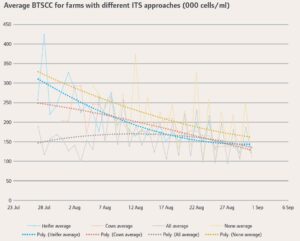
So, after several evolutions, the place of teat sealants can be summed up with the statement that, “All cows and heifers benefit from teat sealants, but some cows may also need antibiotics”. Following such a policy is also paying dividends. The below graph shows the average BTSCC of farms divided by which groups of cows receive teat sealants. It is apparent that, as more teat sealant is used, the initial BTSCC that the herd begins with becomes increasingly lower. Those herds not using it at all have a BTSCC that follows a traditional trajectory, of starting high in spring then slowly coming more under control as the season progresses. This is contrasted by the herds that use teat sealants in both heifers and cows which actually calve in with very low BTSCCs, and which remain more or less stable throughout the early part of spring. Herds using teat sealants in either heifers or cows, but not both, experience a pattern somewhere in between these two outcomes. We see this pattern more and more in practice when we sit down with clients at our milk quality reviews. Years ago, it was common for farms, where mastitis was under control, to still treat 2-4% of their cows each month in August and September, which they could often rein in to around 1-2% by November. These days, we often look at herds that have negligible mastitis in August and September, with 1-2% developing through October into November. The main driver appears to be teat sealants suppressing that early spring mastitis.
As with the learnings in the late 1990s, teat sealants are not without their risks if they are not managed well. However, many farmers are now demonstrating, year after year, that those risks are manageable and that there are significant rewards for using these products (i.e. in reduced cell count, reduced spring mastitis and consequently reduced hassle in spring). If you have not yet embraced teat sealant use on your farming operation, make sure that you have an in-depth discussion about how you could start using these products with your Vetlife veterinarian.